

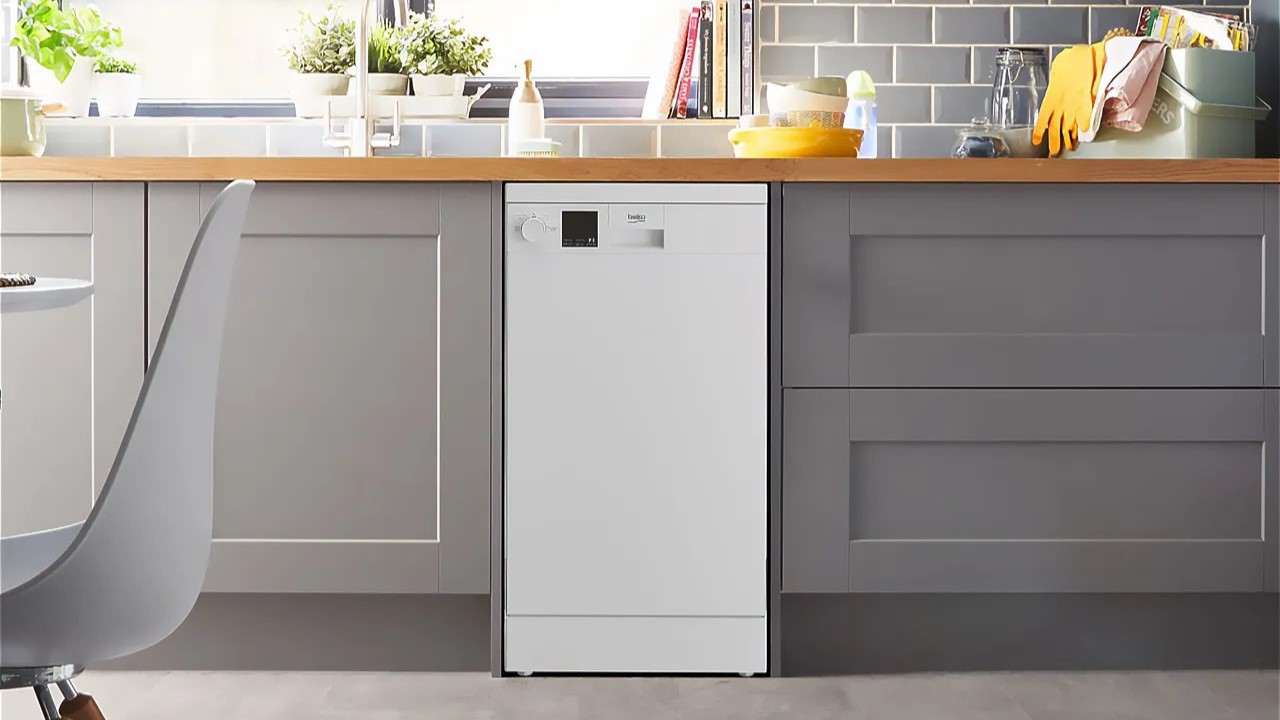
If your kitchen feels like it was designed for a kettle and a prayer, a full-size 60 cm dishwasher can look about as realistic as fitting a grand piano in the hallway. That’s where slimline models come in: same basic job, less width, and — if you choose carefully — surprisingly little compromise. The question isn’t whether slimline dishwashers “work”. It’s whether they’re worth it for your kitchen, habits and expectations.
What “slimline” actually means
In the UK, a slimline dishwasher is typically about 45 cm wide (give or take a millimetre of marketing optimism), versus roughly 60 cm for a standard full-size machine. Height and depth are usually in the same ballpark as full-size models, so the space you save is almost entirely across the width — which is often the only dimension that matters in a tight run of cabinets.
Capacity is usually quoted in place settings. Slimline machines commonly land around 9–10 place settings; full-size models often claim 12–15. Treat those numbers as a rough guide, not gospel: a “place setting” assumes a rather polite dinner plate, bowl, glass and cutlery set — not your roasting tin, air-fryer basket and the mug collection that somehow multiplies overnight.
Freestanding, integrated, or semi-integrated?
Slimline isn’t a separate species of dishwasher — it’s a size. You can still choose:
- Freestanding — finished sides and top; easier to install and take with you if you move
- Fully integrated — hidden behind a cabinet door for a seamless look
- Semi-integrated — door panel matches the kitchen, but the control panel stays visible
In a small kitchen, freestanding can be the pragmatic win: less joinery drama, simpler plumbing, and you can reclaim the appliance if you move. Integrated looks tidier if you’re renovating and already committing to custom doors.
When a slimline dishwasher is worth it
- Width is the bottleneck — you’ve got a 45 cm gap (or can free one) but nowhere near 60 cm
- One or two people — or a small household that doesn’t generate a mountain of crockery every night
- Flats and galley kitchens — where every centimetre of worktop and cupboard run is contested territory
- You’re replacing hand-washing — even a smaller machine beats sinking your evenings into a washing-up bowl
- You want quieter evenings — many modern slimlines are respectably quiet; useful when the kitchen is basically also the living room
When you should think twice
- You cook with big trays and stock pots — oversized items are the classic slimline headache
- Family of four+ with nightly full loads — you may end up running it constantly or finishing by hand
- You hate Tetris — smaller racks reward patient loading; rushed loading wastes capacity
- You host often — entertaining can overwhelm a 45 cm machine in one evening
- You’re choosing slimline only because it’s cheaper — price isn’t always lower once you compare like-for-like features; buy on fit and performance, not width nostalgia
Capacity, cleaning and drying: what you really give up
Space inside
You’re not getting a half dishwasher. You’re getting a narrower one. Plates, bowls and everyday glasses usually fit fine. The pinch points are:
- Large dinner plates stacked beside chunky bowls
- Oven trays, casserole dishes and chopping boards
- Tall stemware if the upper rack isn’t adjustable
Look for adjustable racks, fold-down tines and a cutlery basket (or tray) that doesn’t steal the only spot big enough for your frying pan. Those unglamorous features matter more in a slimline than a flashy “extra intensive” programme you’ll use twice a year.
Cleaning performance
A good slimline from a reputable brand can clean every bit as well as a full-size machine on everyday loads. Problems creep in when people overfill, block the spray arms with a roasting tin “just squeezed in”, or skip basic maintenance (filter, spray arm holes, salt/rinse aid where required). Width doesn’t cause cloudy glasses — hard water and poor setup do.
Drying
Drying quality varies by model more than by slimline vs full-size. Open-door / automatic door-open drying, a decent intensive dry option, and not cramming plastics into a cold corner of the rack will do more for you than obsessing over a couple of centimetres of width. Plastic tubs still dry sulkily in almost every dishwasher — slimline isn’t uniquely cursed.
Running costs, noise and energy labels
Slimline machines aren’t automatically cheaper to run. Water and electricity use depend on the programme, soil level and efficiency of the specific model. On modern UK labels (A–G), compare:
- Energy class and estimated consumption figures on the label
- Water use per cycle (and whether you’ll run eco cycles or quick washes most days)
- Noise in decibels — especially in open-plan or studio living
Eco programmes are usually the efficient choice but take longer. If you live alone and run a quick wash every evening for a handful of items, your real-world costs won’t match the brochure’s “perfectly full eco load” fantasy — and that’s true for 60 cm machines too.
Installation realities in small kitchens
- Services — cold water feed, waste, and a switched fused spur or suitable socket arrangement
- Levelling — uneven floors show up as doors that won’t latch or machines that wander
- Ventilation and heat — freestanding units need the clearance the manufacturer specifies; don’t brick them in “to look integrated”
- Access — getting a dishwasher through a tight flat hallway can be more dramatic than the plumbing
If you’re renting, confirm you’re allowed to install one, and favour freestanding so you can reverse the work later. If you’re owning and renovating, getting the plumber and kitchen fitter aligned before cabinets are fixed saves the classic “perfect 45 cm hole, pipes in the wrong place” moment.
How to decide in five honest questions
- Do I have (or can I create) a true ~45 cm wide space with workable plumbing?
- On a normal day, would a 9–10 place-setting machine clear the sink — or am I still hand-washing pans?
- Do large trays and stock pots appear weekly, or rarely?
- Is the kitchen also where people sleep / watch TV, so noise matters a lot?
- Am I choosing slimline because it fits — or because I’m hoping it’ll fix a lifestyle that really wants full-size capacity?
If your answers point to “fits, enough capacity, I’ll load it properly”, slimline is usually worth it. If you’re already negotiating with a full-size dirty-dish mountain, shrinking the machine rarely shrinks the mountain.
Living happily with a slimline
- Run it when full enough — not one mug at a time — unless you’re using a short programme deliberately
- Wash oversized trays by hand (or in batches) without treating that as failure
- Keep the filter clean; blocked filters punish smaller tubs quickly
- Use the rack adjustments; default positions aren’t sacred
- Accept that “one load equals one day’s dishes” is a guideline, not a personality test