You drain a sink full of washing-up water, open the dishwasher a few minutes later, and there is a grey puddle sitting in the bottom that was not there before. Or the machine smells faintly of the sink, even though you have cleaned the filter twice. Or it seems to "drain" mid-cycle without being asked. Nine times out of ten the culprit is not the dishwasher at all. It is the drain hose, and the way it has been routed under the sink.
The good news is that the usual fix costs nothing more than a cable tie and five minutes on your knees. This guide explains what siphoning and backflow actually are, how to tell which one you have, and how to set the hose up so dirty water only ever goes one way: out.
What is actually happening
Most UK dishwashers drain into the same waste as the kitchen sink, through a small spigot on the side of the sink trap. That is perfectly normal and every manufacturer allows it. The trouble starts when the hose takes a lazy route from the back of the machine to that spigot, because two different things can then go wrong:
- Backflow from the sink. When you pull the plug on a full sink, a surge of water rushes into the trap. If the dishwasher hose runs downhill or flat into the spigot, some of that water simply flows the other way, up the hose and into the bottom of the dishwasher. Food scraps and grease come along for the ride.
- Siphoning out of the dishwasher. If the hose drops below the level of the water in the machine, or the end is pushed too far down a standpipe, gravity can keep pulling water out of the dishwasher once the pump starts it moving. The machine then struggles to hold enough water to wash, keeps topping up, or throws a fill error.
Both problems have the same root cause and the same cure. The hose needs to rise up high before it comes back down to the drain.
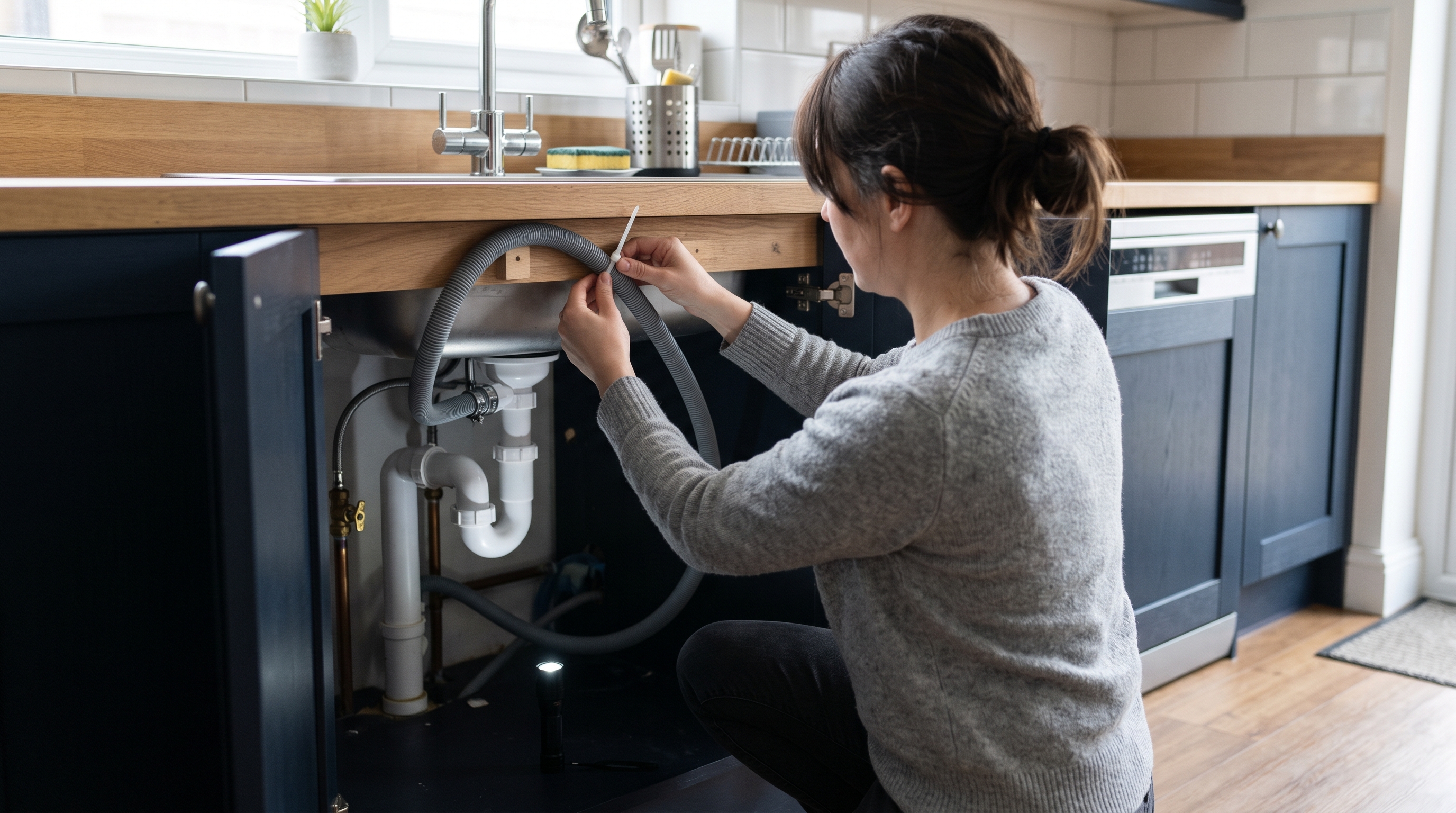
Quick Fix: Look under the sink. If the grey drain hose runs straight across to the trap, or sags down to it, lift it so it loops up to the underside of the worktop, fix it there with a cable tie or hose clip, then let it drop down to the spigot. That single "high loop" cures most cases of dirty water coming back from the sink.
Signs your drain hose is the problem
Siphoning and backflow are easy to confuse with a blocked filter or a failing pump, so it helps to know the tell-tale signs:
- Water appears in the dishwasher after you use the sink, not after a dishwasher cycle. This is the classic backflow symptom.
- The water is cloudy, greasy or has bits in it that look like they came from your washing-up rather than your plates.
- A smell like the sink drain hangs around inside the tub, even with a clean filter.
- You hear the machine filling more than usual, or it stops with a water supply or fill error even though the tap is on. That points to water siphoning out as fast as it comes in.
- The problem started after a new kitchen, a new sink or a new dishwasher was fitted. Hose routing is the first thing to get changed (or forgotten) during installation.
A small amount of clear water left in the sump at the bottom of the tub after a cycle is normal on many machines. What is not normal is a puddle that grows, or water that looks like it came from the sink.
How to check your hose in five minutes
- Switch the dishwasher off at the wall. You will not need to pull it out for this, but it is good practice when poking around near the plug.
- Empty the cupboard under the sink and find the grey ribbed drain hose. It usually comes through a hole in the side panel from the dishwasher next door.
- Follow it to the trap. It should push onto a short plastic spigot on the side of the sink trap or waste pipe, held on with a hose clip.
- Look at its route. Does it rise up towards the underside of the worktop before it drops to the spigot? Or does it come in low, run along the cupboard floor, or connect from below?
- Check where the spigot sits. If the connection point is low down and the hose never gets higher than it, sink water has an easy path back to the machine.
- Look for kinks or a crushed section, especially where the hose passes through the cabinet side or behind the machine.
Setting up a proper high loop
The high loop is the dishwasher equivalent of keeping your feet dry by walking on the kerb. Water from the sink would have to climb uphill to get back into the machine, and it will not.
- Lift the hose so it climbs as high as is comfortable inside the sink cupboard, ideally right up under the worktop.
- Fix it in place with a plastic hose clip, a cable tie through a small screw-in eye, or the plastic hose guide that came with the dishwasher (many machines include one in the bag of bits).
- Let it fall to the spigot without any further dips or sags, and make sure the clip at the spigot end is snug.
- Keep within the height your manual allows. The drain pump can only lift water so far. Manufacturers give a range for the highest point of the hose, measured from the floor the dishwasher stands on. Beko, for example, asks for between 50cm and 100cm, and some Hotpoint manuals give 40cm to 80cm. Under a standard UK worktop the top of a high loop sits around 80cm to 85cm, so check your own model's figure before you cable-tie it to the very top.
- Run a short rinse programme with the cupboard door open and watch the connection for drips while it drains.
Top Tip: If your manual says something odd about drain height, such as a maximum of 10cm, read it again carefully. That kind of figure is almost always a typo or a translation slip for 100cm, or it refers to the distance from the floor rather than the outlet. When in doubt, check the manufacturer's website for the downloadable installation instructions for your exact model number.
If you drain into a standpipe instead
Some dishwashers, particularly ones away from the sink or in an island, drain into a standpipe: a vertical pipe with its own trap, usually behind the appliance. Here the classic mistake is pushing the hose too far down the pipe. If the end of the hose sits in standing water, or the joint is airtight, it can siphon the machine dry.
- Only push the hose a short way into the standpipe and leave an air gap round it. Beko, for example, suggests about 12cm. Do not seal the gap with tape.
- Use the plastic hook or guide supplied with the machine to hold the hose over the top of the pipe so it cannot slide further in.
- Make sure the top of the standpipe is high enough to sit within your manual's drain height range.
Other things that cause backflow
If the hose already has a decent high loop and dirty water still turns up, look at these next:
- A partly blocked sink waste. If the sink drains slowly, water backs up in the trap and has more chance of finding its way up the dishwasher hose. Clear the trap and the pipe beyond it. A plunger or a bendy drain rod usually does it.
- Sharing a waste with the washing machine. Two appliances on one trap is fine if the trap has two proper inlets, but home-made Y-pieces and splitters can push one machine's water into the other. A dual-spigot trap is the tidy answer.
- A missing or failed non-return valve. Many dishwashers have a small one-way valve where the hose leaves the machine, and some sink traps have one built into the spigot. If either has stuck open or been removed, water can flow back. These are cheap parts and simple to replace.
- Too much hose. Long, looping hoses that coil on the cupboard floor create low spots where water collects and sloshes back. Trim the route or tidy it so it rises and falls once. If the hose is actually too short to reach, use the manufacturer's extension kit rather than a random connector.
Warning: Do not connect a dishwasher drain to a surface water drain or an outside gully meant for rainwater. Dishwasher waste must go to the foul drain, the same as your sink. If you are moving the dishwasher or adding a new waste point, that is a job for a plumber.
Clean up after a backflow
Once the hose is sorted, give the machine a fresh start so any sink sludge is not left to fester:
- Take out and rinse the filter under the tap, scrubbing the mesh with an old toothbrush.
- Wipe out the sump area at the bottom of the tub with a damp cloth.
- Run an empty hot programme with a dishwasher cleaner, or a cup of white vinegar on the top rack, to shift grease and smells.
- Leave the door slightly open for an hour afterwards to let it dry out.
Reminder: Every time the dishwasher is pulled out, whether for a repair, a new floor or a kitchen refit, check the drain hose route when it goes back in. It is very easy for a high loop to slip down behind the machine and for the problem to come straight back.
When to call someone in
Most siphoning and backflow problems are fixed with a high loop and a clear sink waste. Call a plumber or appliance engineer if:
- there is no sensible place to make a high loop and the waste connection needs moving;
- the sink waste keeps blocking, which suggests a problem further down the pipework;
- water still comes back after you have fixed the hose, which points to a faulty non-return valve or drain pump inside the machine;
- you can see water damage to the cupboard base or floor under the dishwasher.
Bottom Line: Dirty water coming back from the sink is almost always a hose routing problem, not a broken dishwasher. Loop the drain hose up under the worktop, fix it there, keep within your manual's drain height, and make sure the sink waste is clear. It is one of the cheapest dishwasher fixes there is, and one of the most satisfying.