

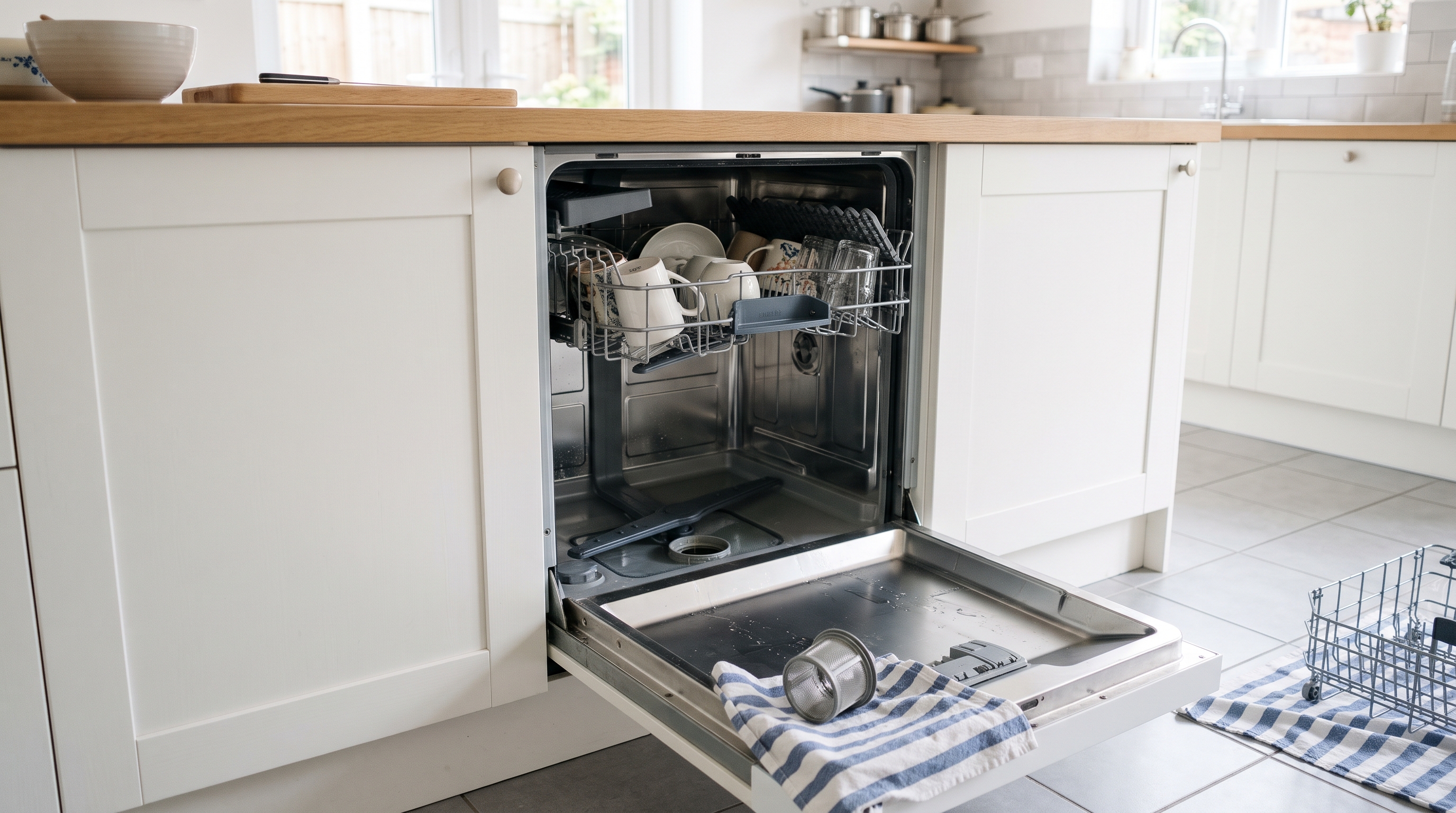
You load up, press start, and hear the reassuring gurgle of water coming in. Then... a hum, maybe a click, and silence where the swooshing should be. Open the door mid-cycle and the dishes are bone dry, with a puddle sitting in the bottom of the tub. It's a maddening fault, because the machine is clearly doing something. The good news is that the most common causes are cheap or free to fix, and you can rule most of them out in half an hour with a towel, a torch and a bit of patience.
First, Make Sure It Really Isn't Spraying
Modern dishwashers use remarkably little water, often around 9 to 12 litres for a whole programme, so a shallow pool in the sump is completely normal. Many eco programmes also spend a long time soaking and heating before the main wash gets going properly. Before you start taking things apart, check these:
- Give it time. Wait 10 to 15 minutes after the water stops filling. Some machines heat water before they circulate it.
- Listen carefully. A working wash sounds like rain against the inside of the door. A steady hum with no splashing, or a buzz that stops and starts, points to a circulation problem.
- Check after a cycle. If the tablet is still sitting in the dispenser or half-dissolved, and the top rack is completely dry, water isn't reaching the dishes.
- Look for an error code. Many machines flag a circulation, heating or water-level fault on the display or with flashing lights. Note it down and check the manual, as it can save you a lot of guesswork.
Cause 1: A Clogged Filter or Sump
This is the most common cause by a distance. The circulation pump draws water from the sump through the filter before pushing it up to the spray arms. If the filter is matted with food, labels, grease or a stray lemon pip collection, the pump simply can't pull enough water through, so it hums away while very little reaches the arms.
- Remove the bottom basket.
- Twist and lift out the cylindrical filter, then lift out the flat mesh plate underneath.
- Rinse both under a warm tap, scrubbing with a soft brush. Avoid wire brushes, which can tear the fine mesh.
- Look into the sump opening with a torch and fish out anything lurking: glass shards, cocktail sticks, bits of foil and olive stones are regular offenders.
- Refit everything firmly. A filter that isn't locked into place can let debris straight into the pump.
Then run a short rinse programme and listen. If the familiar swoosh is back, you're done.
Cause 2: Spray Arms That Are Blocked or Can't Turn
Even with a clean filter, water has nowhere useful to go if the spray arm holes are clogged with limescale or food, or if the arm can't rotate. Spin each arm by hand: it should turn freely and not catch on anything.
- Check for obstructions. A tall chopping board, a baking tray or a pan handle poking down through the rack will stop an arm in its tracks. Load the machine and spin the arms before you close the door.
- Clear the holes. Remove the arms (most clip or unscrew off), run them under the tap and poke out the jets with a cocktail stick. Shake them to check nothing is rattling around inside.
- Descale them. In hard-water areas, which cover much of England, limescale can narrow the jets. Soaking the arms in warm water with a splash of white vinegar or citric acid for half an hour loosens it.
- Check the feed tube. On many machines the upper arm is fed by a pipe running up the back of the tub, which docks with a connector when the top rack is pushed home. If the rack isn't fully in, or the connector is cracked, water won't get to the top arm.
Cause 3: Not Enough Water Getting In (or Staying In)
The circulation pump needs a minimum amount of water to work with. If the level is too low, it sucks air, sounds like it's straining, and sprays little or nothing. There are two very different reasons the water might be too low.
Water isn't coming in fast enough
- Check the tap feeding the dishwasher is fully open. These little isolation valves under the sink are often half-closed after a previous repair.
- Pull the machine out a little and check the inlet hose isn't kinked or squashed behind it.
- Unscrew the inlet hose at the machine end (with the water off and a bowl handy) and check the small mesh filter inside the connection. It can block with grit or limescale, especially after work on the water mains in your street.
- If your machine has an anti-flood hose, with a chunky box near the tap end, a triggered safety valve may be restricting the flow. A flashing water-supply error is the clue.
Water is draining away as fast as it comes in
If the drain hose doesn't rise high enough before it reaches the sink trap or standpipe, water can siphon out of the machine as it fills. You get a machine that fills, sort of, but never has enough water to circulate. Check that the drain hose has a high loop somewhere along its route, ideally clipped to the underside of the worktop, rather than lying flat along the floor. Your manual will give the minimum and maximum heights for your model.
Cause 4: A Jammed or Failed Circulation Pump
If the filter and arms are clean, the water level looks right and you hear a hum or buzz with no splashing, the circulation pump (sometimes called the wash pump or main motor) is the prime suspect. This is the part that does the heavy lifting, and there are a few ways it fails:
- A jammed impeller. A shard of glass or a fruit stone can slip past a poorly fitted filter and lodge in the impeller. The motor tries to turn, can't, and just hums. On some machines you can reach the impeller through the sump with the filter out, but many need the pump removing from underneath.
- A failed capacitor. Many circulation pump motors use a small start capacitor. When it fails, the motor hums but won't spin up. It's a cheap part, but it's electrical work, so only tackle it if you're genuinely confident.
- Worn bearings or a failed motor. This tends to show up on older machines as a grinding noise first, then a hum, then nothing.
- A combined heater pump. Some brands combine the heating element and the circulation pump into one unit. When it fails you often see a heating or circulation error code alongside the lack of spray, and the whole unit is replaced as one part.
Less Common Causes Worth Knowing About
- A loose internal hose. Occasionally a hose inside the casing slips off, often after the machine has been moved. Water can leak into the base, triggering the anti-flood system, and the machine may keep pumping out instead of washing. If you see water in the base tray or a leak warning, look here.
- Door switch or latch faults. If the machine doesn't believe the door is properly shut, it may fill but refuse to start the wash pump.
- Control board or sensor faults. If the pump works when tested but never gets the signal to run, the fault may be in the electronics. This is engineer territory.
Repair or Replace?
A blocked filter or spray arm costs nothing to fix. An inlet hose filter or a drain hose rerouting is a quick DIY job. A replacement circulation pump is a different matter: the part plus an engineer's call-out can add up to a significant chunk of the price of a new mid-range dishwasher.
As a rough rule of thumb, if your machine is under about seven years old and otherwise in good shape, a pump replacement is usually worth doing. If it's older, has had other faults, or the repair quote is creeping towards half the cost of a replacement, it's worth weighing up a new machine, especially as newer models are often quieter and use less water and energy.