

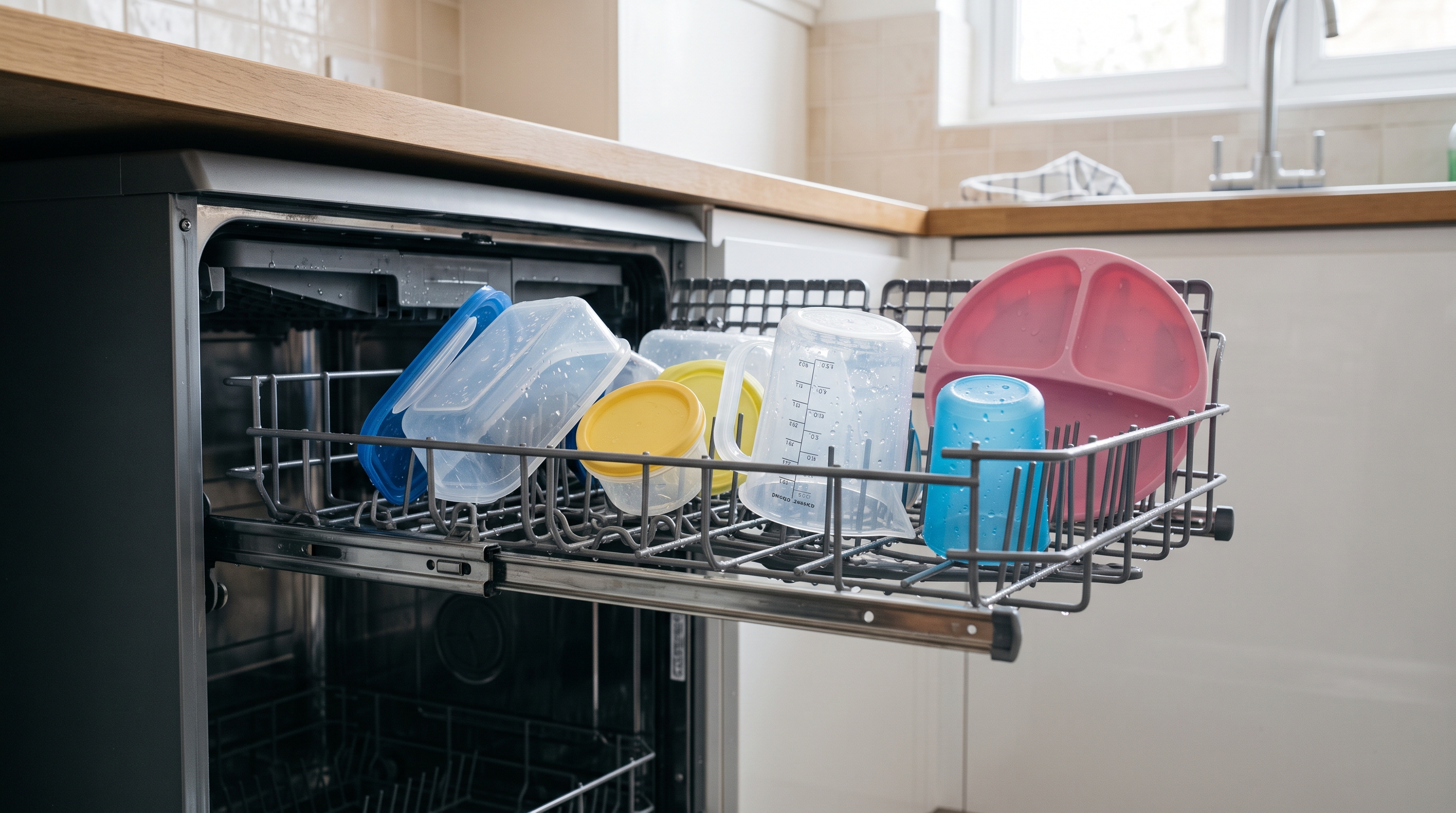
You open the dishwasher, the plates look fine, and every plastic lunch box is still beaded with water. It is one of the most common complaints in UK kitchens, and it is not always a broken machine. Plastics simply hang on to moisture more stubbornly than glass or ceramic, so you need a slightly different approach if you want tubs and lids ready to put away.
This guide explains why plastic stays wet, what you can change today (loading, rinse aid, programme choice), and when soggy plastics are a hint that the dryer itself needs attention.
Quick fix first: put dishwasher-safe plastics on the top rack, angle them so water can run off, top up rinse aid (even if you use all-in-one tablets), and crack the door open for ten minutes when the cycle ends. That trio fixes most “wet Tupperware” days without tools.
Why plastic dries worse than plates
Ceramic and glass hold heat. After the final hot rinse they stay warm for a while, so leftover water evaporates. Plastic cools quickly. Once the surface temperature drops, droplets cling instead of turning to steam. Manufacturers say the same thing in plain English: plastics do not retain heat, so they will often leave the machine wetter than everything else around them.
That means a bit of moisture on lunch boxes is normal on many condensation-drying dishwashers. The goal is not laboratory-dry plastic every time. The goal is far less pooling, fewer tea towels, and spotting the rare case where something is actually broken.
Load plastics so water can escape
Loading mistakes cause more soggy plastic than any fancy feature you forgot to buy.
- Top rack only for dishwasher-safe plastics. The bottom rack sits nearer the heating element on many machines and is hotter. Heat can warp thin tubs and lids.
- Upside down or tilted. Cups, yoghurt pots, and food containers should face down so they do not fill like little bowls. A slight angle helps water sheet toward the drain.
- Leave gaps. Nested tubs and stacked lids trap a film of water between surfaces. One finger of space is enough for air and spray to move.
- Keep spray arms free. Tall bottles or chopping boards that stop an arm spinning leave wet, dirty zones. Spin both arms by hand after you finish loading.
- Lids and small bits. Use the cutlery basket, a clip, or a dedicated small-item rack so lids do not flip and pool water. Check the underside of each lid for the dishwasher-safe mark before you trust it.
Top tip: if a container always comes out with a lake in the corner, change its angle rather than running a longer cycle. Physics beats programme length here.
Rinse aid is not optional for plastics
Rinse aid lowers the surface tension of water so it sheets off instead of beading. Tablets that claim “rinse aid included” still release their dose early in the wash. The dedicated rinse-aid dispenser doses at the right moment in the final rinse, which is when drying performance is decided.
- Open the rinse-aid compartment on the door.
- Fill to the max line without overfilling.
- Wipe spills so you do not get foam next cycle.
- If plastics are still wet after a full refill, raise the dose setting one step (dial inside the compartment or a menu option on digital models).
In hard-water parts of the UK, rinse aid also helps with spotting. Keep dishwasher salt topped up as well so the softener and the rinse chemistry can do their jobs together.
Reminder: check the rinse-aid window or light about once a month, or sooner if drying suddenly gets worse. An empty dispenser is still the number-one reason whole loads feel damp.
Pick a programme that actually dries
Eco and quick programmes are great for energy and time. They are less great for stubborn plastic moisture because they often shorten or soften the drying phase.
- Use a normal or intensive programme when the load is heavy with plastic boxes.
- Turn on Extra Dry, PerfectDry, or similar if your model offers it.
- Avoid switching heated dry off “to save electricity” if wet plastics annoy you more than a few extra minutes of heat.
- Auto-open door models help a lot: steam escapes instead of condensing back onto cool plastic. If your machine has the feature and it is disabled in the settings, switch it back on.
End-of-cycle habits that help
When the beep goes, do not slam the door shut for another hour with a sealed steam bath inside.
- Open the door a hand’s width for 10–15 minutes so humid air can leave.
- Unload bottom rack first so drips from upper plastics do not land on dry plates below — or unload plastics last and tip them out over the sink.
- Shake or tip deep containers once before you put them away. Ten seconds beats a tea towel session.
When wet plastics mean a real fault
If everything comes out cold and wet — plates, pans, and plastics — you are past “plastic is awkward” territory.
- No warmth at the end of a cycle can point to a heating element, thermostat, or drying-fan fault.
- Auto-open doors that never release may need a door-actuator check.
- Blocked filters and spray arms leave greasy, wet loads; clean the filter, clear the arm holes, and retest before you book an engineer.
Book a repair if the tub never feels warm after a full hot programme, if error codes keep appearing, or if drying collapsed overnight on a machine that used to finish bone dry. Plastics will always be the first to show a weak dryer, but ceramic should still be mostly dry on a healthy machine.
Buying note if you hate wet Tupperware
If you are choosing a new dishwasher and plastic containers are a daily reality, look for stronger drying systems: fan-assisted drying, automatic door opening, or mineral systems such as Zeolith (common on some Bosch and Siemens ranges). Condensation-only machines can clean brilliantly and still leave lunch boxes damp. That is a design trade-off, not always a lemon.
Bottom line: wet plastic is often physics plus loading, not a write-off. Top rack, angled containers, real rinse aid, a proper dry programme, and a cracked door after the beep will sort most UK kitchens. If plates are as wet as the Tupperware, then look at heat, fans, and filters — that is when “normal for plastic” stops being the answer.