

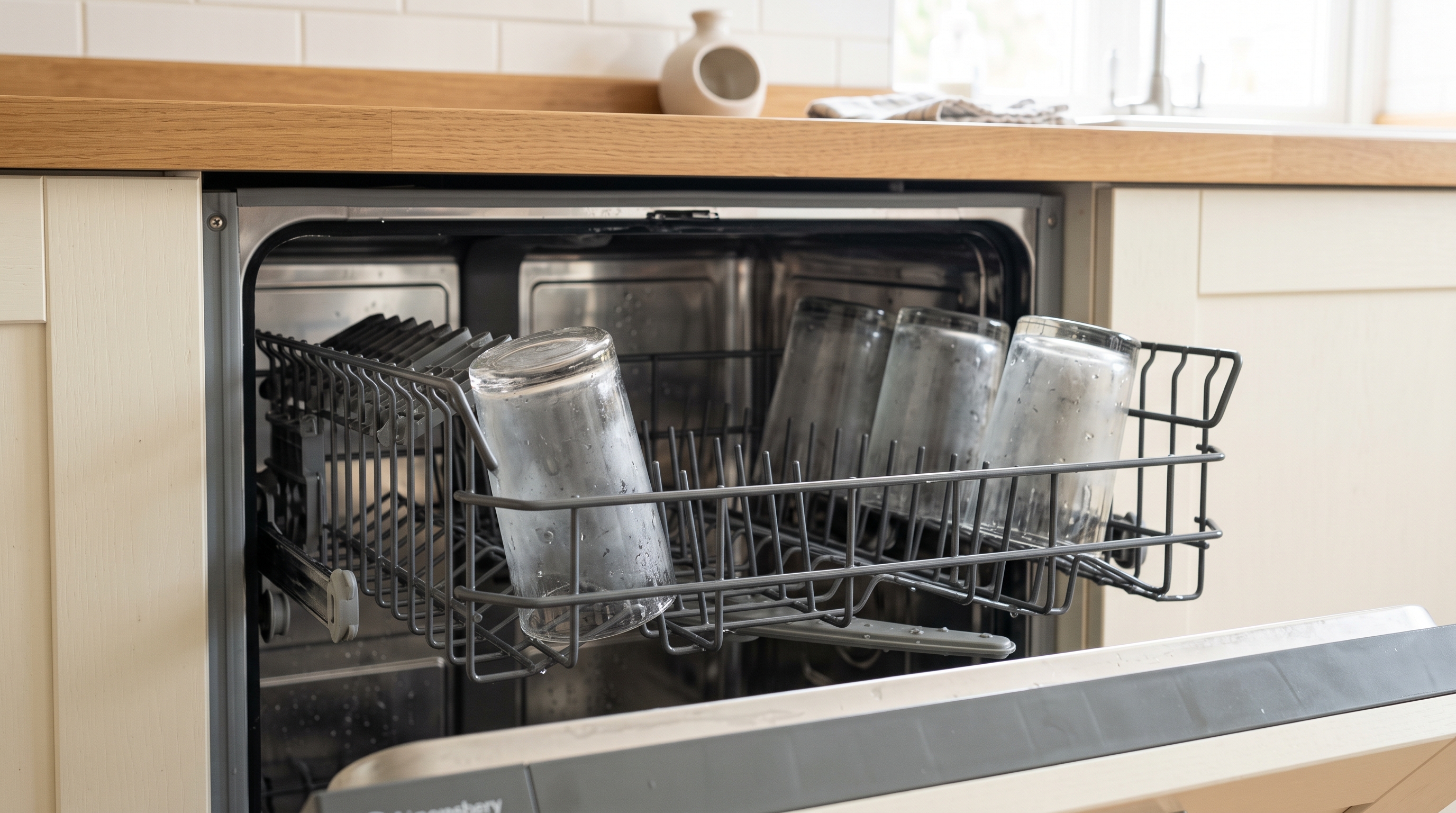
Cloudy glasses are one of those dishwasher mysteries that make you wonder if you are doing everything wrong. You open the door, the cycle looks fine, then your tumblers look foggy, chalky, or weirdly iridescent. In UK kitchens this is extremely common, especially where the water is hard. The good news: most of the time it is not permanent damage. The less good news: if you leave the wrong cause untreated for months, some glasses really do get etched for life.
This guide helps you tell removable film from permanent etching, then walk through the fixes that usually clear it up without calling an engineer.
Quick fix first: top up dishwasher salt and rinse aid, set rinse aid to a mid-to-high dose, and run a normal (not eco-quick) cycle with a fresh tablet. If the cloudiness lifts after one or two washes, you were dealing with mineral film, not ruined glassware.
Is it film, or is it etching?
Before you buy new glasses, do the finger and vinegar tests. They take two minutes and save a lot of guesswork.
- Removable mineral film (limescale / detergent residue): feels slightly rough or chalky; often worse on the outside of glasses; can look white or grey. A drop of white vinegar or a limescale cleaner will usually clear a patch if you rub gently.
- Permanent etching: a dull, frosted, or rainbow haze that sits in the glass. Vinegar does nothing. Rubbing does nothing. The glass feels smooth, just permanently cloudy. Soft-water areas, too much detergent, and very hot cycles make this more likely over time.
Top tip: if vinegar clears a test patch, keep the glasses and fix the machine settings. If it does not, those tumblers are etched. You can still stop it getting worse on the remaining glassware by dialling detergent down and rinse aid up.
A note on older crystal
Everyday tumblers and most modern wine glasses cloud for the reasons above. Older lead crystal is a different case, and it is worth keeping out of the machine.
Traditional crystal is made with lead oxide (full lead crystal is often around 24%). That is what gives it the sparkle and the ring, but it also makes the surface softer and more chemically vulnerable than ordinary soda-lime glass. A hot, alkaline dishwasher detergent can pull alkali and lead ions out of that surface and etch the silica network underneath. The result looks like the same milky fog, but it is permanent — a vinegar wipe will not lift it. The lead is not a film sitting on the glass. The glass itself has been attacked.
Warning: do not put heirloom, hand-cut, gold-rimmed, or unmarked older crystal in the dishwasher, even on a gentle cycle. Makers of traditional lead crystal generally say hand wash only. Modern “crystal” is often lead-free, and some pieces are marked dishwasher-safe — follow that mark, and still use the top rack, less detergent, and no extra-hot dry if you are unsure. If a favourite piece is already cloudy and the vinegar test does nothing, it is etched. New glasses will not reverse it.
Why UK dishwashers leave cloudy glasses
Most British homes sit on hard or moderately hard water. Calcium and magnesium in the wash water dry onto glass as a white film unless the softener, salt, and rinse aid are doing their jobs. Soft-water flats and homes with a whole-house softener have the opposite risk: overdosing detergent can etch glass instead of coating it.
Common causes, in rough order of how often we see them:
- Empty or low rinse aid — water beads and evaporates instead of sheeting off.
- Dishwasher salt empty, or hardness setting wrong — softener cannot strip minerals from the water.
- All-in-one tablets relied on alone in hard water — convenient, but often not enough rinse aid or softener help on their own.
- Overloaded or cupped loading — water pools in bowls and glass bases, then dries into marks.
- Too much detergent / too hot a programme on soft water — chemistry that slowly eats the glass surface (etching).
- Dirty filter or blocked spray arms — leftover soil and detergent redeposit as a hazy film.
Step-by-step: clear removable cloudiness
1. Refill salt and rinse aid properly
Open the salt compartment in the base of the tub (usually under a screw cap). Fill with dishwasher salt only — table salt is the wrong grain size and can damage the softener. Wipe spills so salt crystals do not sit on the stainless steel. Then fill the rinse aid dispenser in the door until the indicator shows full, and set the dose dial or menu to around the middle. In hard-water areas, nudge it higher after a couple of cycles if spotting remains.
2. Check the water hardness setting
Many Bosch, Beko, Hotpoint, AEG and similar UK machines let you set water hardness in the menu or with a combination of buttons. If the setting is too soft for your postcode, the softener under-doses and glasses stay cloudy. Your water supplier’s website usually lists hardness for your area; match the dishwasher’s chart in the manual.
3. Clean the filter and spray arms
Twist out the filter cylinder, rinse under the tap, and scrub trapped food with an old toothbrush. Pop the spray arms off if your model allows and poke out blocked holes with a wooden cocktail stick. Gritty or milky film often improves dramatically once water can actually reach the top rack.
Frequency reminder: rinse the filter every few washes in a busy household. Give spray arms and the door seal a proper clean about once a month, then run a hot empty maintenance cycle.
4. Run a hot cleaning cycle
Place a dishwasher cleaner (or a bowl of white vinegar on the top rack — never mix vinegar with bleach) and run the hottest empty programme. This lifts detergent grease film that makes glasses look permanently dull even when they are only coated.
5. Adjust detergent and programme
In hard water, a quality tablet plus separate rinse aid and salt usually beats hoping the “all-in-one” claim covers everything. In soft water, use less detergent (or a gentler tablet) and avoid unnecessary intensive 70°C cycles for everyday glassware. Eco cycles are fine for energy, but if glasses are still wet and spotted, try a standard auto or intensive wash while you dial settings in.
Loading habits that keep glasses clear
- Angle glasses so water drains from the base — do not nest them tightly.
- Keep glasses off the bottom rack if your machine runs very hot there; top rack is gentler.
- Leave space between stems so spray jets can reach every surface.
- Do not block the rinse aid dispenser door with a large tray on the bottom rack.
- Unload the bottom rack first so drips from above do not spot freshly cleaned glass.
Rescuing glasses that are already cloudy
For removable film, soak glasses in warm water with a splash of white vinegar or a citric acid descaler made for glassware, then rinse and polish with a soft microfibre cloth. Avoid abrasive scourers — they scratch and make future clouding worse.
For etched glass, polishing will not bring the clarity back. Retire the worst offenders to garden-party duty and protect what is left with better salt, rinse aid, and detergent dosing.
Warning: never pour neat bleach into the dishwasher to “fix” cloudy glasses, and never mix bleach with vinegar or acidic cleaners. You want clearer tumblers, not a chemistry experiment in the kitchen.
When to call for help
If salt and rinse aid are topped up, hardness is set correctly, the filter is clean, and glasses are still coming out chalky after several normal cycles, the softener valve or rinse aid dispenser may have failed. That is a parts job rather than a settings tweak. Likewise, if only the top rack is filthy or cloudy while the bottom looks fine, spray-arm or diverter issues are worth an engineer’s look.
Bottom line: most cloudy dishwasher glasses in the UK are mineral film from hard water plus skimpy rinse aid — fixable in an afternoon. Confirm with a vinegar patch test, refill salt and rinse aid, clean the filter, and tune hardness and detergent. Save the bin bag for glasses that fail the vinegar test and are truly etched.